How Much God Loves You
Homily for the Twenty-Fifth Sunday after Pentecost
November 15, 2026

Homily for the Twenty-Fifth Sunday after Pentecost
November 15, 2026
Homily for November 15, 2026
The Twenty-Fifth Sunday after Pentecost
Matthew 25:14-30
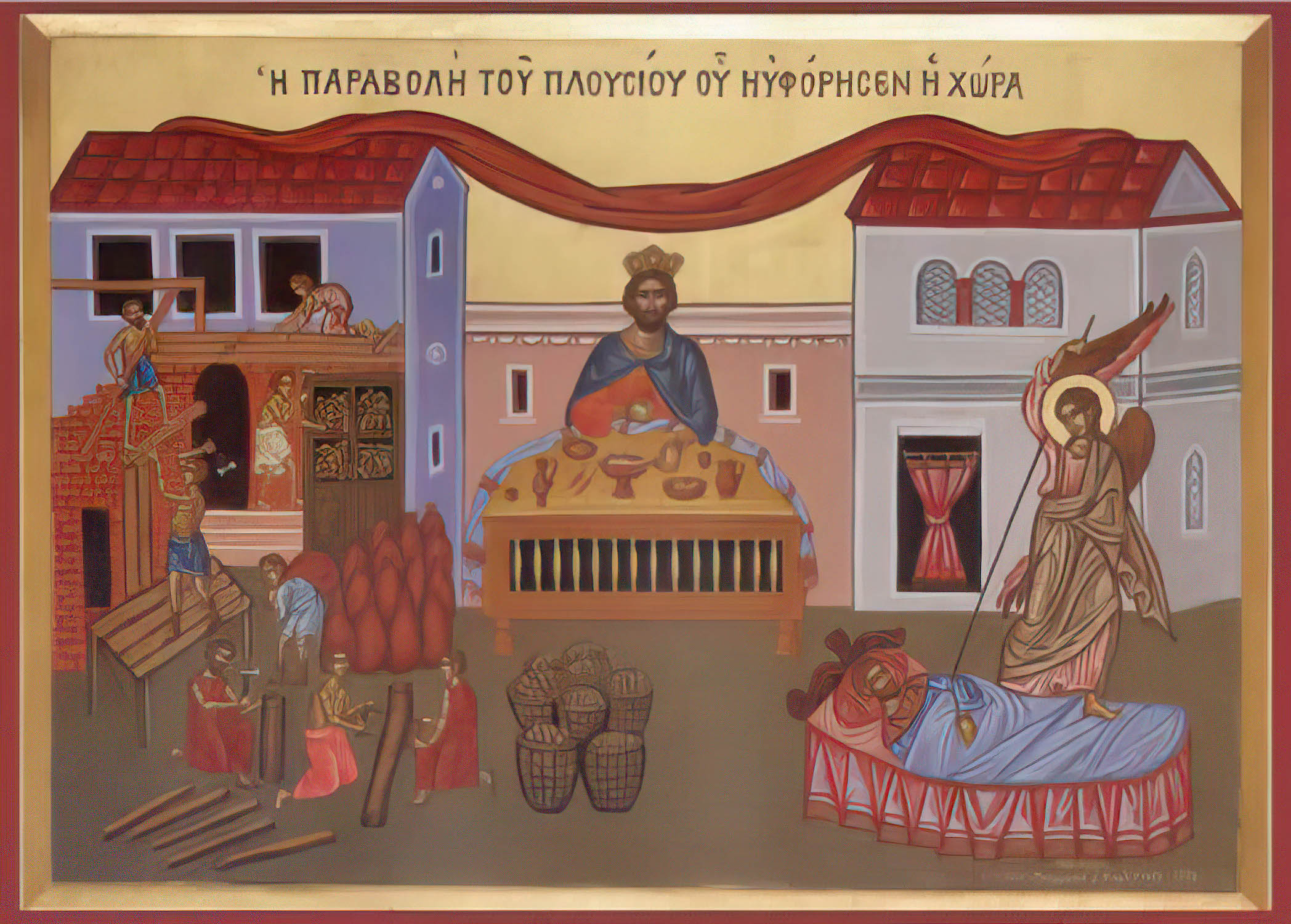
Today’s Gospel lesson, the so-called “Parable of the Talents,” is the third in a series of four parables in Matthew chapters 24-25 about our need to be ready for the Παρουσία, or the “arrival,” of Jesus at his second coming. In today’s parable the first two servants were ready: the first used his five talents to make five more talents, and the second used his two talents to make two more talents. But the third servant was not ready. Instead of using his talent to make another talent, he “went and hid [his] talent in the ground.” When the master returned and learned that the slave had not used but buried his talent, he said to him, “You wicked and lazy slave… you ought to have invested my money with the bankers, and on my return I would have received what was my own with interest.”
These four parables about theΠαρουσία in Matthew 24 and 25 are troubling on account of the harsh punishments meted out upon those who were not ready. In the “Parable of the Unfaithful Slave,” the unfaithful slave upon the master’s return is “cut to pieces” and put with the hypocrites, “where there will be weeping and gnashing of teeth” (24:51). In the “Parable of the Ten Bridesmaids,” the foolish bridesmaids, are shut out of the wedding banquet: “Lord, open to us,” they said. “Truly I tell you, I do not know you,” he replied (25:11-12). And in today’s parable, the master said of the servant who his talent in the ground: “As for this worthless slave, throw him into the outer darkness, where there will be weeping and gnashing of teeth.” If, as Matthew seems to suggest, the “master” or the “bridegroom” in these parables is Jesus, how can Jesus – whom we are told is all mercy and love – execute such harsh judgment?
Two things. First, a scene from The Last Battle,the seventh and final book in C.S. Lewis’ The Chronicles of Narnia. After the last battle in which Aslan’s followers have been routed by the forces of Shift, the ape, Aslan takes Lucy, Edmund and Peter to the “New Narnia” (or “heaven”). As expected, the New Narnia is filled with light and beauty. There they find a group of dwarfs huddled together in what they believe is a dark, stench-filled barn. Lucy begs Aslan to help the dwarfs see the green grass and blue skies around them. Aslan replies, “Dearest Lucy, I will show you what I can do and what I cannot do.”
Aslan raised his head and shook his mane. Instantly, a glorious feast appeared on the Dwarfs’ knees: pies and tongues and pigeons and trifles and ices, and each dwarf had a goblet of good wine… But it wasn’t much use… They thought they were eating and drinking only the sort of things you might find in a stable. One said he was trying to eat hay and another said he had got a bit of an old turnip and third said he’d found a raw cabbage leaf. And they raised golden goblets of rich red wine to their lips and said, “Ugh! Fancy drinking dirty water out of a trough that a donkey’s been at!”
“You see,” said Aslan. “They will not let us help them. They have chosen cunning instead of belief. Their prison is only in their minds, yet they are in that prison; and so afraid of being taken in that they cannot be taken out.”
The second thing… is a person, the seventh-century saint, Isaac of Nineveh, also known as Isaac the Syrian. St. Isaac believed that God is above all immeasurable love, and Isaac’s writings and homilies are dominated by this conviction that God is love. “Among all his actions,” writes Isaac, “there is none which is not entirely a matter of mercy, love and compassion.” For Isaac, the whole purpose of creation, and the purpose of Jesus’ incarnation, is “to reveal God’s boundless love to the world.” “In love did He bring the world into existence,” Isaac writes…
… in love does He guide it… in love is He going to bring it to that wondrous transformed state, and in love will the world be swallowed up in the great mystery of Him who has performed all these things… And since in the New World the Creator’s love rules over all rational nature, the wonder at His mysteries that then will be revealed will captivate the hearts of all rational beings whom He has created, whether they be evil or whether they be just, so that they might have delight in Him (II.38.1-2).
Or again:
There is no one “who is to the front or to the back of God’s love. God has a single equal love that covers the whole extent of rational creation, all things visible and invisible: There is no first or last place with Him in His love for any single one of them” (II.38.2).
We see God’s love in this morning’s parable. The master is generous, giving his servants talents, which were equal to 6,000 days of the laborer’s daily wage. Note how well the master knows his servants, giving “to each according to his ability.” Note how the master trusts his servants – “he entrusted his property to them,” says Jesus. Note, too, how the master is joy-filled and wants his servants, too, to share in his joy – “enter into the joy of your master,” he says. If the “master” is indeed God, this God is good, and he loves his servants!
A perhaps hidden way in which God loves us is that the servants have free will. As powerful as God is, there is one place God does not reign omnipotently, which is the human heart. The one thing God cannot command is for us to return his love. Because he so deeply loves us, God will never violate our free will.
Like Edmund, Lucy and Peter with Aslan in the “New Narnia,” we are surrounded by God’s truth, goodness and beauty. Like the dwarfs chose, we could make the choice not to see God’s love; we could choose “cunning instead of belief,” as Lewis put it. The first two servants chose belief, choosing to see the goodness, generosity and love of the master and living their lives accordingly. The third, like the dwarfs, refused to see. In burying his treasure, he buried also himself. The third servant is not so much condemned as he condemns himself to a living hell blind to the loving kindness of God.
I will leave us with two questions: If you truly could see how much God loves you, how might you live your life differently? And, Is there anything getting in the way of your truly seeing how much God loves you? Maybe take some time this afternoon to consider these questions, and maybe invite Jesus to consider with you: If you truly could see how much God loves you, how might you live your life differently? And, Is there anything getting in the way of your truly seeing how much God loves you? I pray that God may give you the grace to live your life – in every moment, in every encounter – as though you truly could see God’s vast, immense, unending love for you. Yes, you!






Homily for the Seventeenth Sunday after Pentecost



















Homily for the Marriage of Joel Diamond and Eliza Cotter

Homily for the Feast of the Baptism of Our Lord