The Complexity of Thomas
Homily for the Second Sunday of Easter
April 12, 2026
Homily for the Second Sunday of Easter
April 12, 2026
Homily for Sunday, April 12, 2026
The Second Sunday of Easter
John 20:19-31
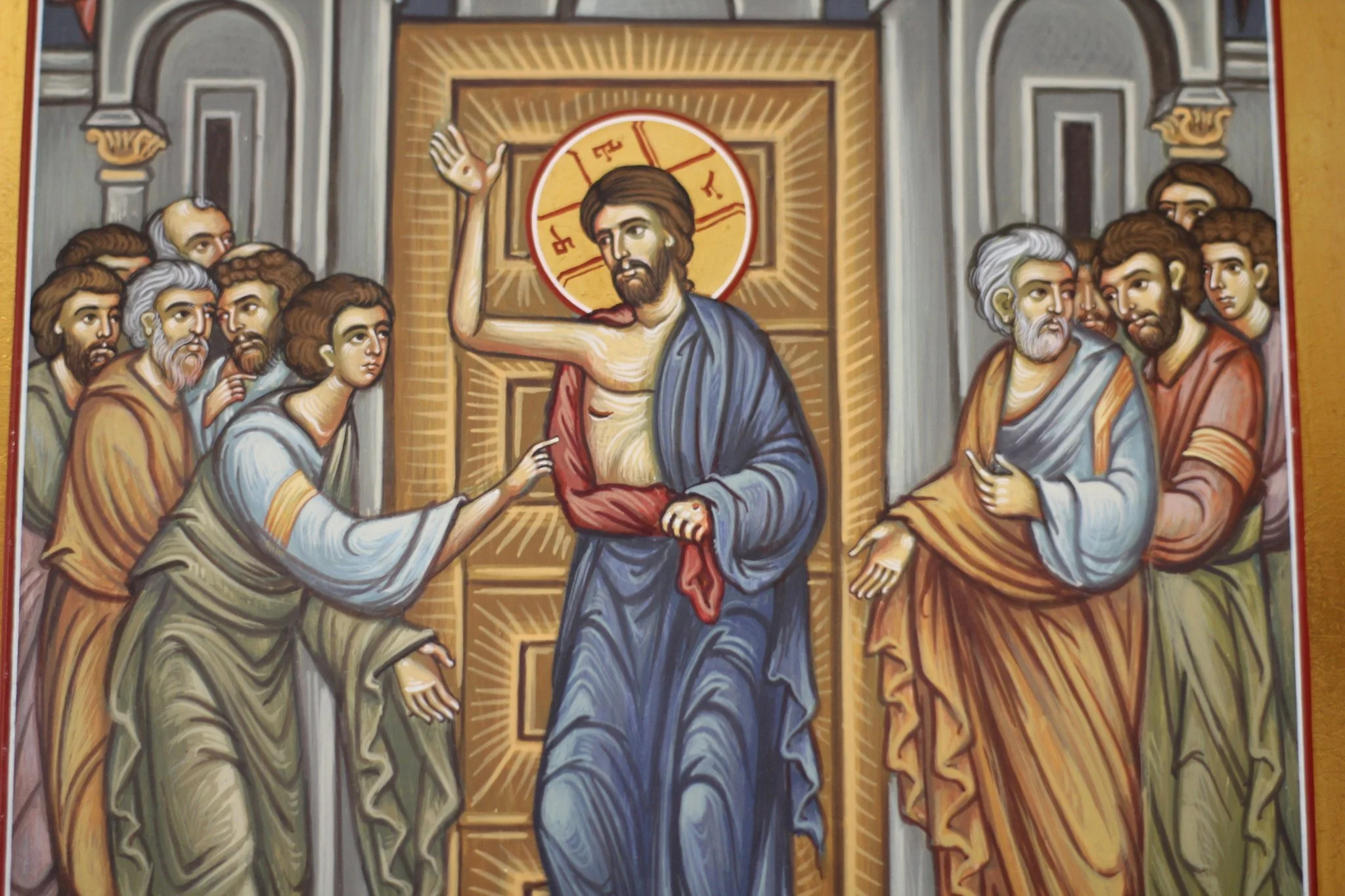
Listening to this morning’s Gospel lesson from John chapter 20, our ears most likely are drawn to Thomas. Thomas is the one disciple named, and it is Thomas with whom Jesus converses. To pigeonhole Thomas as “Doubting Thomas” misses the richness and complexity of Thomas. To better appreciate Thomas and the role he plays in St. John’s Gospel, we are going to consider this passage in context. First we will go back to the Easter Vigil last Saturday. Then we will take a brief look at the creation account in Genesis chapter 1. And lastly, we will look also at the priestly ordination rites in Leviticus chapter 8.
First, the Easter Vigil. The darkness in which the Vigil begins calls to mind the chaos and void of the first verse of Genesis: “When God began to create the heaven and the earth, the earth was complete chaos, and darkness covered the face of the deep.” At the Vigil, we read the scriptures in the dark in order to bring to mind the time before creation and to emphasize that when we proclaim Easter – “Alleluia! Christ is risen!” – and the lights come on, it is as though it is once again the first day of creation – there was darkness, and there was light. Note how in today’s reading the disciples are meeting 1) at evening, and 2) in a house with the doors shut – the disciples are in the dark or nearly so when Jesus “came and stood among them.” Though dark, Jesus yet can “show them his hands and his side” because he is the “Light of the world”(John 8:12), “the true light,” which has now enlightened the disciples (e.g., John 1:9).
Second, undergirding John’s Gospel is yet more from the Genesis creation account. For example, the opening words of John echo the opening words of Genesis: “In the beginning was the Word,” John writes. And if on the first day of creation God created light, the first verses of John speak of Jesus as “the light” that “shines in the darkness.” Or in John chapter 20, recall that the resurrection story of Jesus meeting Mary Magdalene, like Genesis chapter 2 takes place in a garden. Further, many commentators see in John connections between Jesus’ seven “signs,” or miracles,and the seven days of creation; and between Jesus’ mother, whom in chapter 2 he called “woman,” and Eve, whom Adam also named “woman;” and some find connections, too, between the “wind” that swept over the face of the waters before creation and the “wind” spoken of by Jesus to Nicodemus in John chapter 3. Undergirding much of John’s Gospel is the Genesis creation account.
And lastly, the rites of ordination in Leviticus chapter 8. What we call the story of “Doubting Thomas” in John chapter 20 mirrors the ordination of Aaron and his sons in Leviticus chapter 8 – in John, Jesus in effect “ordains” his disciples. For example, if in Leviticus Moses anointed Aaron and his sons with oil, in this morning’s Gospel Jesus “breathed on them and said to them, ‘Receive the Holy Spirit.’” If in Leviticus Moses reached into the sacrificed ram of ordination and took out “all the fat that was around the entrails, the appendage of the liver, and the two kidneys with their fat” (Lev8:25), in John Jesus invited Thomas to, “Reach out your hand and put it in my side.” And if in Leviticus Aaron and his sons were not to “go outside the entrance of the tent of meeting for seven days,”until the day when their ordination was complete (Lev 8:33), in John, “A week later the disciples were again in the house” with the doors shut. In this morning’s Gospel lesson, Jesus in effect “ordains” his disciples.
Given the context of the Easter Vigil, of the creation account in Genesis and of the ordination of Aaron and his sons in Leviticus, Thomas begins to become more rich and complex than merely “Doubting Thomas.” This Thomas could be said to be a new Adam. He along with his fellow disciples could be considered to be a new Aaron and his sons. And this richer, more multi-dimensional Thomas can be for us an example of what it means to faithfully follow Jesus as his disciple.
Thomas could be said to be anew Adam. As Adam was part of God’s first creation of the world, so is Thomas part of Jesus’ re-creation of the world at his resurrection. And not only is Thomas present at the beginning of this new world, but Thomas offers humanity the possibility of a do-over in believing God’s word. For if the first Adam did not obey God’s command not to eat of the tree of the knowledge of good and evil, when Thomas said, “My Lord and my God!” Thomas obeys Jesus’ command to, “Believe in God, believe also in me” (John 14:1). Thomas is the spiritual “Adam” or “father” of all “those who have not seen and yet have come to believe.” Thomas is a new Adam.
Along with the other disciples,Thomas is like a new Aaron and his sons – priests. Though Thomas was not initially present when Jesus breathed on them and said, “Receive the Holy Spirit,” yet similar to what Moses did in the ordination of Aaron and his sons, Thomas “put his finger here and saw Jesus’ hands,” and he “reached out his hand and put it in Jesus’ side.” After the disciples’ week-long period of ordination, similar to how the priests in the Old Testament made sin offerings on behalf of the people, now these disciples-become-priests can “forgive the sins of any, [and] they are forgiven them;” and if they “retain the sins of any, they are retained.”
This richer, more multi-dimensional Thomas can be for us an example of what it means to faithfully follow Jesus as his disciple. Being like a “new Adam,” we are 1) to walk not in darkness but as children of light (John 12:35-36). 2) We are to be “in Christ,” in whom we are a new creation (2 Cor 5:17). And 3) we are to be “ambassadors” for Christ,who is reconciling the world to himself (2 Cor 5:19-20). Being a “priest” means that 1) we are to be agents of holiness in our fallen world, proclaiming “the excellence of him who called us out of darkness and into his marvelous light” (1 Pet 2:9). Being a “priest” means 2) we are to live our lives according to God’s will, presenting “our bodies as a living sacrifice,holy and acceptable to God” (Rom 12:1). And being a “priest” means that are to live lives of service in such away that we (to quote Revelation) become “a kingdom of priests serving our God”(Rev 5:10).
As we are like Thomas “new Adams,” and as we are like Thomas “priests,” we will be sustained in this new way of life as we allow Jesus to come to us in all parts of ourselves,including those places in which the “doors” might be shut out of fear. It is not always easy to let Jesus in – we like Thomas may well have doubts about Jesus, whether he truly is present and if he indeed has the power to save. But perhaps when we like Thomas recognize his wounds and “put our finger here and see his hands”and “reach out our hand and put it in his side,” we will not merely see but have a felt interior knowledge of this Jesus who loves us and was willing to lay down his life for us. And then perhaps we with Thomas will know the peace that only Jesus can offer, and with Thomas confess that Jesus is, “My Lord and my God.”


Homily for the Seventeenth Sunday after Pentecost

















Homily for the Marriage of Joel Diamond and Eliza Cotter

Homily for the Feast of the Baptism of Our Lord