To See As The Lord Sees
Homily for the Fourth Sunday in Lent
March 15, 2026
Homily for the Fourth Sunday in Lent
March 15, 2026
Homily for March 15, 2026
The Fourth Sunday in Lent
John 9:1-41
Shakespeare fans may recall how his plays often contain a “play within a play” – in theater-speak, mise en abyme; literally, “placed into the abyss.” These “plays within a play,” in which the audience watches actors in a play watch other actors in another play, give the playwright a different kind of “stage” to either enhance the drama of the primary play or to make social commentary. For example, in Act 3 of Hamlet,a troupe of travelling actors plays “The Murder of Gonzago,” in which a king is poisoned by his brother who then marries the dead king’s wife – which is in miniature the plot of Hamlet. At the end of A Midsummer Night’s Dream, a traveling troupe of working-class actors performs “Pyramus and Thisbe,” in which Shakespeare parodies the melodrama of upper-class romantic love. And in The Taming of the Shrew, nearly the entire play is performed as a “play within a play.” Here, mise en abyme gives Shakespeare a safe stage on which to comment on the social hierarchies and gender expectations of the Elizabethan era.
Today’s Gospel story of Jesus healing the man born blind is John’s version of a mise en abyme. After Jesus tells the blind man to “Go, wash in the pool of Siloam,” Jesus steps away from the “stage,” as it were. In the “play within the play” that follows we can watch the neighbors, the man, his parents and the Pharisees ask questions about what just happened: “How were your eyes opened?” “How can this man who is a sinner perform such signs?” “Is this your son… How does he now see?” “What did he do to you? How did he open your eyes?” The mise en abyme ends when Jesus returns to converse with the man (9:35-39) and to challenge the Pharisees (9:40-41).
As Shakespeare did in Hamlet, it could be that John uses this mise en abyme to present in miniature the plot of his Gospel: though the “Light” is often rejected, those who see come to believe. Or as Shakespeare did in A Midsummer Night’s Dream, it could be that John uses his mise en abyme to parody, in this case the Pharisees: though the [ostensibly seeing] Pharisees accuse the blind man of being “born… in sin” (9:34), in the end it is the Pharisees whom Jesus suggests are blind and whom he tells, “Your sin remains” (9:41). Or perhaps as Shakespeare did in The Taming of the Shrew, John uses his “play within a play” as social commentary, in this case about the religious authorities: how John’s community was likely to be in conflict with them, and how they, too, like the blind man, might be put out of the synagogue.
We don’t know why John wrote his “play within a play.” But given the liturgical context of today’s passage – 1) it is the third in a series of four passages from John’s Gospel during the Sundays in Lent; 2) these four passages were used by the early Church to help catechumens prepare for Baptism at the Easter Vigil; and 3) this passage is paired with the Old Testament lesson from 1 Samuel, whose punchline is, “The Lord does not see as mortals see; they look on the outward appearance, but the Lord looks on the heart” – [given the liturgical context of this passage,] it could be that the Church chose this passage for today to help us begin to “see as the Lord sees,” which is: life without Jesus on our “center stage” is more difficult.
The past two weeks I have referenced the story of Alypius in Book 6 of Augustine’s Confessions. Alypius was Augustine’s student and friend who, once having witnessed the spectacle of the Roman gladiatorial games, couldn’t pull himself away. Returning again and again to view the violence, Alypius “imbibed a savageness,” wrote Augustine, “and became delighted with the guilty context and drunken with the bloody pastime” such that (says Augustine) from what he had seen, Alypius “became wounded in his soul more deeply than were the gladiators in their bodies.” It could be that we are like Alypius, I said. Though we may be safe in our bodies, our eyes daily not in amphitheaters but on phones and computers witness a state-produced “spectacle” of violence: of drones attacking boats, of masked men with guns in city streets, of officers making violent arrests, of tattooed prisoners subdued behind bars, and– more recently – of war in Iran. As Alypius was wounded in his soul by what he had seen, so, too, might we be wounded in our soul by what we see. And just as Alypius’ friends needed to stage an intervention to pull him away from what he had seen, so, too, might an intervention be needed to help us heal from the “spectacle” we have seen.
The scripture lessons for the Sundays in Lent offer an intervention for healing wounded souls. Today’s story of Jesus healing the man born blind encourages us “to see as the Lord sees.” Not to see like Alypius, who was unable to pull himself away and who delighted in the violent “spectacle” of the Roman state;but to see rather “as the Lord sees” and to “look on the heart.”
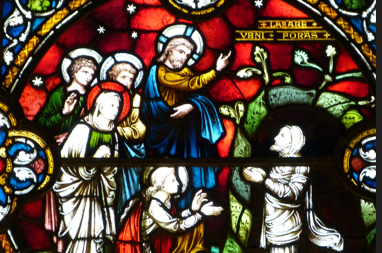
We are called to look in our own heart and to see the ways in which we may have been wounded and stand in need of Jesus’ healing. We are called to look in our own heart and to see that, like the woman at the well, we, too, desire “living water” (4:10-11). And we are called to look in our own heart to see the ways in which we, like Lazarus, may have been dead and buried so long that “there is a stench” and then to hear Jesus’s voice calling us by name to “Come out!” from the tomb (11:43).
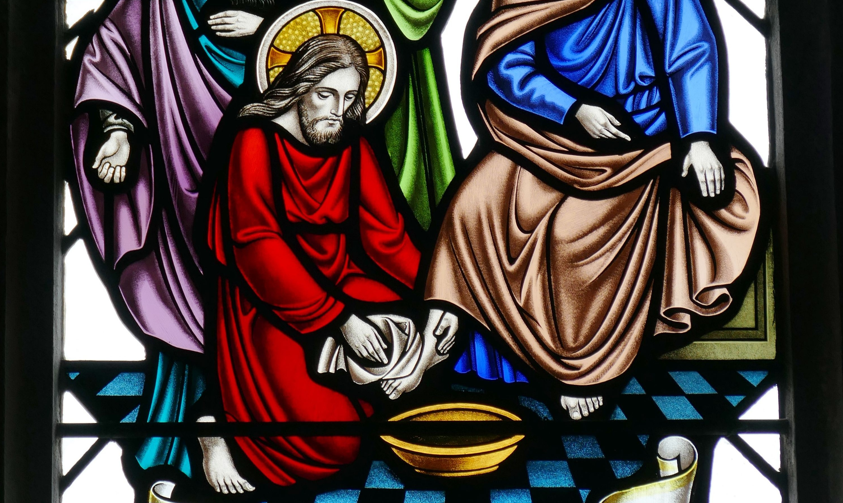
And we are called to “see as the Lord sees” not only our own heart, but also the hearts of others, especially those sheep who may not yet belong to his fold. They – to borrow imagery from John – [they] are those whom God so loved, that” he gave his only Son, that everyone who believes in him may not perish but may have everlasting life” (3:16). They are the crowd whom Jesus fed with the five loaves and the two fishes and to whom Jesus said, “Whoever comes to me will never be hungry, and whoever believes in me will never be thirsty” (6:35). They are all those whom, when Jesus is lifted up, he will draw to himself (12:32). And they are those whose feet we may be called to wash (13:1-11).
We don’t know why in the story of Jesus healing the man born blind John has Jesus step away from “center stage” and creates a “play within a play.” But I pray that today’s lessons may remind us of the power of our sight, how our sight can both wound us, and with God’s help also can heal us. May God give us the grace to see Jesus at our “center stage” and to make him our lives’ priority. May God give us the grace to see how much better our lives are with Jesus in it; to see how Jesus loves us, leads us, guides us, is with us and revives our souls. And to see how his goodness and mercy does indeed follow us all the days of our lives.
























Homily for the Marriage of Joel Diamond and Eliza Cotter


Homily for the Feast of the Baptism of Our Lord