Overpowered by Bafflement
Homily for the The Fourth Sunday of Advent
December 21, 2025

Homily for the The Fourth Sunday of Advent
December 21, 2025
Homily for Sunday, December 21, 2025
The Fourth Sunday of Advent
Romans 1:1-7
Last December, the New York Times’ poetry critic, Elisa Gabbert, wrote:
A friend recently asked me what poetry is for… Another day, I might have answered differently, but on that occasion, I surprised myself by using the word “religion.” I was thinking of structure and practice – of daily-ness and weekly-ness, of ritual, tradition, the way that returning again and again to foundational texts… makes a certain order of experience more possible… I was thinking, too, of bafflement, and of something like submission – the willingness to be overpowered.
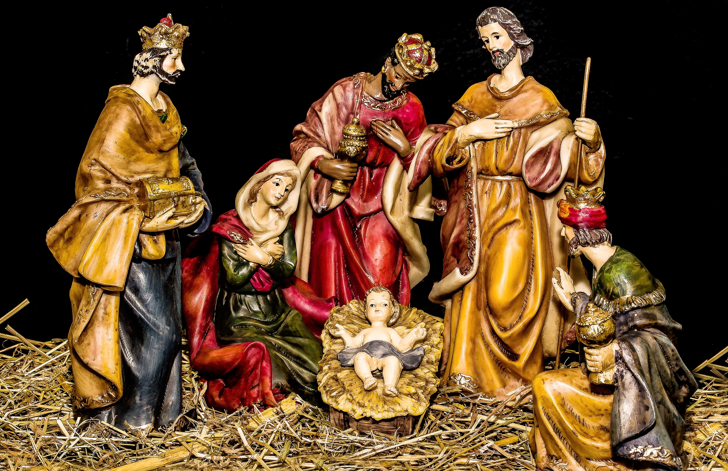
We might wonder, we might be baffled, why this morning, on the Fourth Sunday of Advent just before Christmas,the lectionary chose for our epistle reading the opening verses of Paul’s Letter to the Romans. We might expect to hear a story about Mary and Joseph, as we did in the Gospel lesson from Matthew. We might expect to hear a prophecy about the birth of a child who shall be called “Immanuel,” as we did in the reading from Isaiah. But to hear the opening verses from Paul’s Letter to the Romans might leave us wondering, might leave us baffled.
Perhaps the framers of the lectionary chose this morning’s reading because in it Paul speaks of incarnation: “Paul… set apart for the gospel of God… the gospel concerning his Son, who was descended from David according to the flesh.” Perhaps the framers chose this lesson because it alludes to the reason why the Son became flesh: that he might win for us “resurrection from the dead.” Or perhaps they chose this reading because it points to the intended scope of why the Son became flesh, which is, “to bring about the obedience of faith” not only among Jews but also “among all the Gentiles.” Whatever the reason, this morning’s verses from the opening of Paul’s letter to the Romans do bring us, through Paul’s own experience, to “religion,” to “structure and practice,” to “something like submission” and “the willingness to be overpowered.”
“Religion,” as we might recall, literally means to “re-ligament,” or “to bind together again.” In Jesus, Paul found himself in a new way “bound together again” both to his people and to God. Paul relates his experience of “re-ligamenting”in his letter to the Galatians: “You have heard, no doubt, of my earlier life in Judaism. I was violently persecuting the church of God and was trying to destroy it.” But then“the one who had set me apart before I was born… was pleased to reveal his Son to me” (Gal 1:13-16).
Paul’s being re-ligamented to his people and to God was so powerful that Paul wrote not merely of being “in Christ” – “We are one body… in Christ,” he writes in Romans (Rom 12:5) –but he wrote also of Christ being in him: “I have been crucified in Christ,” he wrote to the Galatians, “and it is no longer I who live, but Christ who lives in me” (Gal 2:20).
In the Incarnation that we are about to celebrate, Jesus made explicit a “re-ligamenting” between God and humanity; he made possible a relationship in which (to quote John) God came and dwelt among us, so that we might abide in him and he in us (John 1:14; 1 John 4:13). God’s becoming human has led to much bafflement – how can one who is fully divine also be fully human? But I have a hunch that in our deepest selves, as there seemed to have been in Paul, we long for structure and practice, for daily-ness and weekly-ness, for ritual and tradition. I have a hunch that we long even for “bafflement, [for] something like submission – the willingness to be overpowered” by the One whom we know (as Paul said) “loved me and gave himself for me” (Gal 2:21). So if we would “re-ligament,” to reconnect in a deeper and more profound way to God, our neighbors and ourselves, could there be a better way to do so than with the“religion” that Paul uncovered in Jesus Christ?
The opening of Paul’s letter that we read this morning on the Fourth Sunday of Advent, in context with the rest of Paul’s writings, helps to set us up for the “poetry,” if you will, of the Incarnation – of the “bafflement” of the Son becoming human, of the“submission” of Jesus taking the form of a servant, of Jesus’ “willingness to be overpowered” and to obedient to the point of death, even death on a cross(Phil 2:7-8). The essence of the Incarnation is to allow ourselves to let the same mind be in us that was in him,to be in something like submission to, and to have a willingness to be overpowered by, Jesus Christ, whose “religion” can re-ligament and bind us together again in wholeness with God, our neighbors and ourselves.
Why not this Christmas season ask God for the grace to allow Jesus to become incarnate ever more fully in you, to allow yourself to live more fully in him and he in you?
Having spoken of “poetry” and the Incarnation, I will leave us with a poem about the mutual indwelling relationship, and the mutual “surrender,” between God and humanity. Here is John Donne’s “Holy Sonnet XV:”
Wilt thou love God, as he thee? Then digest,
My soul, this wholesome meditation,
How God the Spirit, by angels waited on
In heaven, doth make his Temple in thy breast.
The Father having begot a Son most blest,
And still begetting, (for he ne’r be done)
Hath deigned to choose thee by adoption,
Coheir to his glory and Sabbaths endless rest;
And as a robbed man, which by search doth find
His stol’n stuff sold, must lose or buy it again;
The Son of glory came down, and was slain,
Us whom he hath made, and Satan stolen, to unbind;
‘Twas much, that man was made like God before,
But,that God should be made like man, much more.

Homily for the Seventeenth Sunday after Pentecost


















Homily for the Marriage of Joel Diamond and Eliza Cotter

Homily for the Feast of the Baptism of Our Lord