About Feet
Homily for Maundy Thursday
April 2, 2026
Homily for Maundy Thursday
April 2, 2026
April 2, 2026
Maundy Thursday
John 13:1-17, 31b-35
In January, after the clergy met to discuss our shared Holy Week liturgies, and after Tammy asked if I would preach this evening, I (apparently) wrote in my calendar for today, April 2: “Brief, [comma,] about feet.” That’s not to say that’s what Tammy said, but rather what I heard: “Brief, about feet.” Though the homily is on the brief side, and though I will speak about feet, the homily this evening ultimately is not about feet. The homily is about: What kind of relationship would you like with Jesus?
But let’s begin with feet… Quentin Tarantino’s movies are famous for many things (and not just violence). For example, his movies are famous for pop-culture infused dialogues – recall the gangsters’ breakfast in Reservoir Dogs over which they discuss the lyrics to Madonna’s “Like a Virgin” and Charles Bronson’s role in “The Great Escape.” His movies are famous for non-linear story telling – you might remember, for example, how Pulp Fiction jumps back and forth in time. Tarantino’s movies are famous, too, for their eclectic sound tracks, such as in Kill Bill: Vol 2 for which Tarantino used music from the old “spaghetti Westerns” The Mercenary and Navajo Joe. Quentin Tarantino’s movies are famous for many things.
One of the less-famous things for which Tarantino’s movies are known is scenes of feet. For example, in Once Upon a Time in Hollywood, Pussycat (played by Margaret Qualley) while sitting in the passenger seat puts her bare feet up on the dashboard and chats to Cliff (played by Brad Pitt), who drives. When she presses the bottoms of her feet up against the windshield, we can see he extensively calloused souls. Might Tarantino have intended the prominently-displayed callouses to foreshadow the turn that their relationship later would take when Pussycat becomes “callous” toward Cliff? Or again in Once upon a Time… Sharon Tate (played by Margot Robbie) is shown in a movie theatre resting her bare feet on the seat back in front of her. Viewers can see that – despite the gleaming white boots she wears elsewhere in the movie – the souls of her feet are filthy. Could it be that Tarantino portrayed her feet filthy to show that, even though she recently had become a famous actress, yet in her “soul” she remained herself and “down to earth”? Or in Inglorious Basterds the double-agent for the British, Bridget von Hammersmark (played by Diane Kruger) is shot in the leg and must wear a cast. With one unharmed foot elegantly wearing a high heel and the other in a cast, could it be that Tarantino is trying to help viewers grasp the psychological burden of living as a double agent? About Tarantino’s use of feet one reviewer said: “Anytime Tarantino shows feet on screen, we should know that an allegory for life is present. The bare foot can symbolize some of the most beautiful aspects of life” – like vulnerability, trust and intimacy – “while the dirt represents the gritty struggles that we push through.” Our feet literally walk us through our lives’ journey – through times of vulnerability, trust and intimacy, as well as through gritty times of hardship.
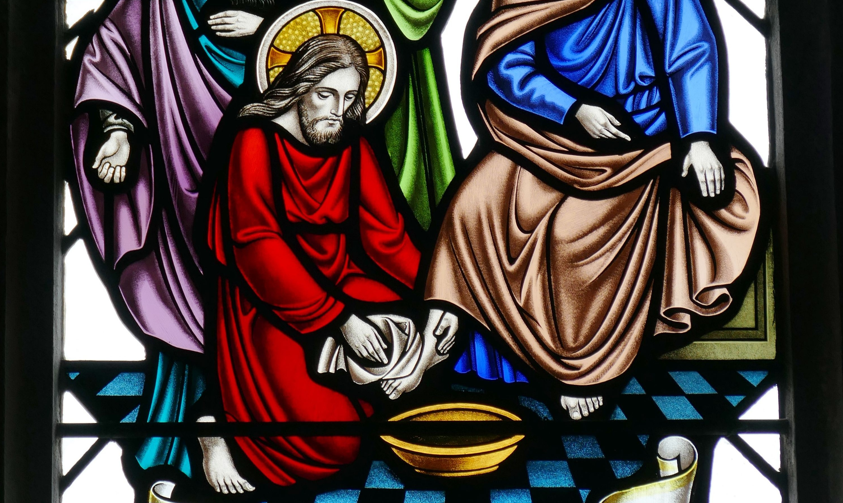
In chapter 13 of St. John’s Gospel (from which we just heard), Jesus could have chosen to wash, say, the disciples’ hands. Or he could have chosen to wash the disciples’ faces, or perhaps (as Peter suggested) their heads. But Jesus chose to wash not hands, faces or heads – he chose to wash the disciples’ feet.
By washing the disciples’ feet,Jesus brings into play all that we might associate with feet: journeys and walking; vulnerability, trust and intimacy; hardship, dirt and grime. When Jesus washes the disciples’ feet, he in effect says: “I am with you through all of it – everything you have ever walked through, I have been there with you, and I am not afraid to touch.” And by allowing Jesus to wash their feet, the disciples in effect respond: “We trust you to know everything about us. We are OK to let you in on the ‘dirt’ of our lives.” And perhaps most importantly, by allowing Jesus to wash their, feet the disciples communicate to Jesus their steadfastness and constancy: “We are no going anywhere. We are taking off our shoes and will be present to you now.”
Tonight begins the first of three days of what is essentially one liturgy. In this liturgy are moments of tenderness and vulnerability – tonight Jesus and his disciples share the Last Supper. In this liturgy are trials and hardship – tomorrow, we accompany Jesus to the cross. In this liturgy is a journey – over these three days we move from death to life. And tonight, the “opening night” of our liturgy, Jesus invites us to do for each other and he has done for us: “If I, Your Lord and Teacher, have washed your feet, you also ought to wash one another’s feet.”
It may not be easy to take our shoes off and to let another wash our feet – in tonight’s Gospel lesson even Peter objected to Jesus’ washing his feet. But I wonder, What kind of relationship would you like with Jesus? Would you like a relationship of vulnerability,trust and intimacy; a relationship in which we are OK to let Jesus draw near and to know all the “dirt” of our lives and to touch us; a relationship marked by constancy and faithfulness and by “I’m not going anywhere but am here for you now”? And, if so, what might be a powerful and memorable symbol of stepping into that relationship more fully and intentionally?
The old Anglican quip about making Confession probably applies also to the footwashing: “All may, none must, some should.” (I count myself among the “Some should.”)
Tonight, at the beginning of this three-day liturgy, I invite us to consider Jesus’ invitation: “If I, Your Lord and Teacher, have washed your feet, you also ought to wash one another’s feet.” I invite us to consider the kind of relationship we would like with Jesus. And I invite us to consider, too, as we prepare to accompany Jesus to his death and celebrate his resurrection, what might be for you a powerful and memorable symbol of stepping into relationship with Jesus more fully and intentionally?
“All may, none must, some should.”

Homily for the Seventeenth Sunday after Pentecost



















Homily for the Marriage of Joel Diamond and Eliza Cotter

Homily for the Feast of the Baptism of Our Lord