Love Heals
Homily for the Fifth Sunday in Lent
March 22, 2026
Homily for the Fifth Sunday in Lent
March 22, 2026
Homily for Sunday, March 22, 2026
The Fifth Sunday in Lent
John 11:1-45
Located in greater Nashville,Tennessee, Thistle Farms is a non-profit serving women survivors of prostitution,trafficking and addiction. Founded by one of my colleagues, The Rev. Becca Stevens (who visited with our Diocesan clergy last spring), Thistle Farms offers women two years of free housing, healthcare,counseling and job training. Thistle Farms’ motto is “Love heals.” To hear testimonials of women who have been through the program is both gut-wrenching and inspirational. At Thistle Farms, Becca said, “We love these women back to life.” For those who may be skeptical of miracles, I encourage you to check out Thistle Farms.
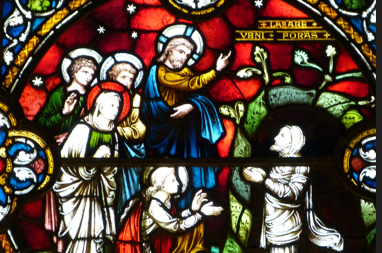
I will get back to Thistle Farms with its motto, “Love heals,” but first, Dostoyevsky’s Crime and Punishment. In part four, chapter four of Crime and Punishment, the protagonist Raskolnikov – who has committed a double murder and gotten away with it – visits his friend Sonya, the prostitute, whom he knows to be a faithful Christian. He asks her to read to him the story of Lazarus that we just heard. When she chokes up already at the first words – “Now a certain man was ill” – Raskolnikov assumes that she does so because the story holds such meaning for her. But we the readers know that the “certain man” who is ill is Raskolnikov, who has – in his own words later in the chapter – not only killed the women but, “I killed myself.” “You’ve done what?” Sonya shrieks. Then clarifies, “What have you done to yourself?” For Sonya intuits that though Raskolnikov maybe “alive,” yet now in his soul is he as dead as the two women he killed.
In his text Dostoyevksy doesn’t quote the entirety of the reading – it’s quite long, as we just heard –but he does quote verbatim two sections. First, verses 19-27, the exchange between Martha and Jesus that includes the famous line, “I am the resurrection and the life,” and that culminates in Martha’s equally famous confession of faith – “Lord, I believe that you are the Messiah, the Son of God, the one coming into the world.” Dostoyevsky takes up the story again beginning at verse 32, the exchange between Mary and Jesus, in which Mary, the crowd and also Jesus weep and in which the onlookers say, “See how he loved him!”
In his Gospel John could have omitted these encounters between Martha and Jesus, and also between Mary and Jesus, and still told the story of Jesus raising Lazarus from the dead. The clue as to why John included these two encounters in the story perhaps is found in the passage’s emotional and relational language. For example, when the sisters send a message to Jesus about Lazarus, they do not say, “Lazarus is ill,” but rather, “Lord, he whom you love is ill.” Two verses later John writes that “Jesus loved Martha and her sister and Lazarus.” Speaking to the disciples, Jesus does not say, “Lazarus has fallen asleep,” but rather, “Our friend Lazarus has fallen asleep.” The passage tells how those present “consoled” Martha and Mary (11:19, 31). Jesus “was greatly disturbed in spirit and deeply moved,” writes John (11:33). Many in the passage, including Jesus, are said to weep (11:31-35). And in verse 36 the onlookers say of Jesus, “See how he loved him!”
Though previously in John’s Gospel Jesus is somewhat aloof – “Jesus would not entrust himself to them,” wrote John in chapter 2 (2:24) – beginning here in chapter 11, John’s language becomes more emotional and relational. Soon, beginning in chapter 13, he will wash their feet; he will tell them to “love one another as I have loved you” (13:34); he will promise to go and “prepare a place for you… so that where I am, you may be also” (14:1,3); he will promise an “Advocate, to be with you forever” (14:16); he will say, “Those who love me will keep my word, and my Father will love them, and we will come and make our home with them” (14:23); he will call them “friends” (15:15); and – the greatest example of his intimacy, the love than which there is none greater –Jesus will lay down his life for his friends (15:13). If the first part of John’s Gospel can be said to be about “believing” – of the 98 times the word “believe” appears in John, 76 occur in the first twelve chapters – the last part of John’s Gospel can be said to be about “love” – of the 39 times the word “love” appears in John, 27 occur in the last nine chapters. Chapter 11 (from which today’s Gospel comes) marks the turning point from “believing” to “love,” with Jesus’ first encounter, with Martha, being about “believing” –“Do you believe?” Jesus asks Martha; “Yes, Lord, I believe that you are the Messiah” – and with Jesus’ second encounter, with Mary, being about “love” – “When Jesus saw [Mary] weeping… he was deeply moved,” and he, too, “began to weep.” “See how he loved him,” the onlookers said.
These two encounters – between Jesus and Martha, and Jesus and Mary – outline the path of discipleship that, suggests John, leads to resurrection and life. For John “believing” is not intellectual assent – not once in his Gospel does John speak of “believing about;” John writes always “believing in.” And not once in John does “belief” appear as a noun; for him, “believe” is a verb. For John “to believe” means to be in relationship with – to “come” to Jesus and to “see” him (e.g., 1:39;4:29; 11:34), to receive Jesus (1:12), to remain with him and to abide with him, (e.g., 1:30; 15:4). Once we “believe in” Jesus – once we’ve allowed ourselves to come to, see, receive, remain and abide with him – we cannot but help, suggests John, to love him. And when we allow Jesus to love us… Well, “Love heals,” and we open ourselves to resurrection and life.
Spoiler alert: Hearing Sonya read the story of Lazarus plants the seed for Raskolnikov’s “resurrection.” He turns himself in to the authorities, he is sent to a Siberian prison for eight years, and at the end Sonya – who has moved to Siberia to be near Raskolnikov (to “abide” with him) – meets him at sunrise on the banks of the river along the edge of the prison camp. If up until that point even in prison Raskolnikov has remained locked in the safety of his mind and his rationalizations, and has continued to keep Sonya at a distance…
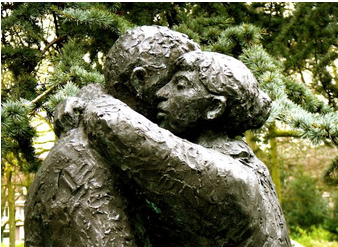
All at once something seemed to seize him and fling him at her feet. He wept and threw his arms around her knees…At the same moment she understood… She knew and had no doubt that he loved her beyond everything… [Their] sick palefaces were bright with the dawn of a new future, of a full resurrection into anew life. They were renewed by love; the heart of each held infinite sources of life for the heart of the other.
For Dostoyevsky, we are Raskolnikov – we stand in need of resurrection. I wonder, taking cues from John’s Gospel,might we allow ourselves to “believe” in Jesus – to come to him, to see him, receive him, to remain and abide with him? And having allowed him near, might we allow ourselves to love him? “Love heals.” We are the one whom Jesus loves and who is ill. We are the one whom Jesus calls “friend” and who has “fallen asleep.” Allowing him near and allowing him to love us, perhaps in some way all at once, something will seem to seize us and fling us at his feet. Perhaps we will know and have no doubt that he loves us beyond everything. And it will be our faces that are bright with the dawn of a new future, of a full resurrection into a new life.

Homily for the Seventeenth Sunday after Pentecost

















Homily for the Marriage of Joel Diamond and Eliza Cotter

Homily for the Feast of the Baptism of Our Lord