Rivers of Living Water
Homily for the Day of Pentecost
May 24, 2026

Homily for the Day of Pentecost
May 24, 2026
Homily for May 24, 2026
The Day of Pentecost
John 7:37-39
Baptism of Lixia Zhu
Gospel lessons from John tend either to be long – remember those Gospel lessons in Lent when we were standing, like, forever? – or, conversely,they tend to be short. At only three verses today’s Gospel is the shortest of the Sunday Gospel lessons from John. But these three short verses are rich with meaning for us who seek to follow Jesus ever more closely.
Speaking of following Jesus ever more closely… Julia, it has been a blessing to accompany you as you have encountered Jesus and as you seek to follow him more closely. I’ll get back to John and his Gospel, but first I want to say to you – and to all of us – that though you may regard yourself as new to following Jesus, witnessing your encounter and deepening relationship with Jesus has served to remind us at Trinity why we ourselves follow Jesus. For those at St. John’s, let me bring you up to speed… In our catechumenate sessions, you (Julia) have spoken of the peace that Jesus brings. “God like the sun has come into my heart,” you said. Haven’t we all experienced moments of that peace that Jesus gives – a peace not as the world gives (John 14:27), but only as Jesus can give, like the sun shining in our heart? “Before I knew Jesus, I was depressed,” you once said, “but with Jesus I have so much joy inside.” “Yes,” I remember thinking, “Because of Jesus I have joy, a joy I often take for granted.” Julia, you help to remind us of the joy that comes from knowing Jesus. Or when you asked about being baptized on Pentecost, and when you learned that Pentecost this year fell on May 24, you said, “May 24? My birthday is May 26! This year I will be born into a new life.” For those of us baptized years ago, it can be easy to forget the significance of Baptism. Julia reminds us that in Baptism we are born into a new life.
Back to John’s Gospel and the riches it offers as we consider the peace and joy and new life that Jesus brings... As mentioned, today’s three short verses are rich with meaning. We could focus on, “The last day of the festival, the great day,” which would have been the last day of the Feast of Tabernacles, also called the Feast of Booths (also called Sukkot), a festival that celebrates how during their time in the wilderness God fed the people with manna, gave them water from the rock and “tabernacled” among them –three things Jesus himself does in John. Or we could talk about the connection between today’s passage and the woman at the well in chapter 4: “Let anyone who is thirsty come to me,” says Jesus in today’s passage, “and let the one who believes in me drink.” In John chapter 4 Jesus tells the woman at the well, “Everyone who drinks of this water will be thirsty again, but those who drink of the water that I will give them will never be thirsty” (John 4:13-14). Or we could talk about the connection between today’s passage and Isaiah chapter55: “Ho, everyone who thirsts,” the prophet writes…
Come to the waters; you that have no money, come, buy and eat!... Why do you spend your money for that which is not bread, and your labor for that which does not satisfy?
Today’s three short verses are rich with meaning. But given that (at least for Luke) Pentecost marks the birth of the Church, given that we are baptizing Julia today and that Baptism is a sharing in Jesus’ death, and given that motherhood is important to you, Julia – your mother and you yourself being a mother – [given all these,] this morning I want to focus on the connection between this morning’s passage from John chapter 7 and Jesus’ crucifixion in John chapter 19.
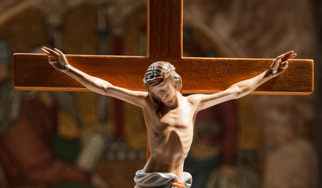
The theme of thirst in today’s lesson points not only back to the woman at the well in chapter 4 but points also forward to the crucifixion: “After this, when Jesus knew that all was now finished, he said… ‘I am thirsty’” (John 19:28). If in today’s lesson Jesus invites those who are thirsty to come to him, on the cross it is Jesus who is thirsty. Also in today’s passage John writes: “For as yet there was no spirit, because Jesus was not yet glorified.” In John,Jesus’ being glorified is synonymous with Jesus being crucified. By these three short verses in chapter 7, John bends the arc of his narrative toward Jesus’ crucifixion.
If we follow John’s clues in today’s passage and look ahead to his account of the crucifixion, we see that for John the Church is born at the foot of the cross. If for Luke the Church is born on the Day of Pentecost, for John the Church is born at the foot of the cross. And for John, the Church is much more literally “born.” Note how in John and only in John at the foot of the cross is Jesus’ mother. Note, too, in John – in contrast to the Synoptics, in which the women gather “at a distance” (e.g., Lk 23:49) – [note in John] how many women are “standing near the cross” as if to assist in that birth: “his mother, and his mother’s sister, Mary the wife of Clopas, and Mary Magdalene” (19:25). Note how in John the soldier pierced Jesus’ side with a spear, and “at once blood and water came out” (19:34)… as they do in all births. Note, too, when Jesus died, John writes that Jesus “παρέδωκεν the spirit,”translated by the NRSV as “he gave up his spirit” (19:30), but which doesn’t capture the intimate, personal nature of the “yielding up” and “handing over” – the “birth,” if you will – of his Spirit. Furthermore, Jesus’ mother appears only twice in John, at the wedding at Cana (2:1-12) and then again at the crucifixion – Jesus’ mother is present for the wedding and then for the birth. And if in today’s passage our translation says that “Out of the believer’s heart shall flow rivers of living water,”the original Greek κοιλίας refers to a hollow or cavity in the abdomen, which would then more literally read: “Out of the believer’s belly,” or, “Out of the believer’s womb shall flow rivers of living water.” For John, the Church is born – literally born – at the foot of the cross.
Julia,I realize I’ve said much this morning, some of it even in Greek. Let me summarize in plain English. You are ready to be baptized. You know that Jesus is about love. You have tasted something of his peace and his joy. You know that to be baptized is to be born into a new life. And you have begun to wrestle – as we all do – with the meaning of Jesus’ death. You are well on your way to making meaning of Jesus’ death. I say so because after you helped read the Passion Gospel on Palm Sunday – remember helping to read the story about Jesus’ death? – I asked you what the experience was like. You said that when you were reading you felt Jesus close to you. “Jesus suffered so much,” you said, “He bore so much for me.” And you added, too, that in every family there is someone who bears the burdens – “Usually the mother,” you said. Today – on the Church’s“birthday,” if you will – we gather as we do at every Eucharist at the foot of the cross. Not at a distance, but close. We gather with “his mother, and his mother’s sister, Mary the wife of Clopas, and Mary Magdalene.” And the Spirit that Jesus yielded up and handed over to those women who were gathered as if to assist in a birth, this same Spirit Jesus will yield up and hand over to you as we gather around you, assisting in your “birth.” We pray that Jesus like a mother may bear you,and bear you up, in this new life. And we pray that after your new “birth,” rivers of living water may flow forth from within you to a thirsty world that needs the love, joy and peace of Jesus more than it knows.

Homily for the Seventeenth Sunday after Pentecost











Homily for the Marriage of Joel Diamond and Eliza Cotter
Homily for the Feast of the Baptism of Our Lord