How Much God Loves Us
Homily for the Third Sunday after Pentecost
June 14, 2026

Homily for the Third Sunday after Pentecost
June 14, 2026
Homily for Sunday, June 14, 2026
The Third Sunday after Pentecost
Matthew 9:35-10:23
Before we consider the story of Jesus naming the disciples in this morning’s Gospel, I want to turn to St. Isaac of Nineveh. Isaac of Nineveh was a seventh-century Syriac monk who for a few months served as Bishop of Nineveh before returning to live in the deserts of present-day Iran. Among Isaac’s remaining writings is commentary on John 3:16 in which Isaac states that –contrary to much medieval theology – it was not so much because of sin that God sent his only-begotten Son into the world, but rather simply because God loved the world.
God did not do this (the Incarnation) for any other reason than to manifest to the world the love that He had, so that by the love of us… the world would be captivated toward loving Him.
And for Isaac, God’s love for the world is not merely for our benefit but also for God’s. For Isaac, Jesus is “the King who lives by love,” and who desires a “return” for his love.
Further, when John writes that “God so loved the world,” Isaac understands “world” to mean not just humanity but all creation. “The death of the Lord took place,” Isaac writes, “[so that] the world might experience the love that God has toward all creation.”
Keeping in mind what Isaac said about God’s great love for us, and that Jesus is “the King who lives by love” and who desires a “return” for his love, and that God’s love for the “world” includes also love for creation, let us now turn to this morning’s Gospel lesson.
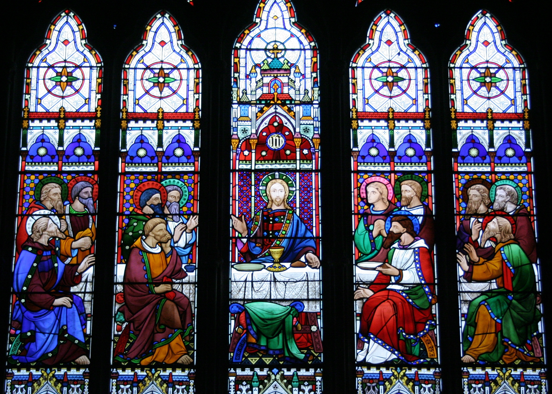
Aside from slight variations in the name lists, what sets Matthew’s naming scene apart from Mark’s and Luke’s is the setting. In Mark,immediately after Jesus names the disciples, the narrator rather anticlimactically writes: “Then Jesus went home” (3:20). In Luke, before naming the disciples, Jesus spent the night in prayer (6:12), and immediately after went down the mountain and began his “Sermon on the Plain” (6:20ff). Matthew’s account possesses an urgency found neither in Mark nor Luke. In Matthew the crowds are, “harassed and helpless, like sheep without a shepherd.” Seeing them Jesus said, “The harvest is plentiful, but the laborers are few.” In Matthew, Jesus did not merely “call to himself those whom he wanted” (as in Mark); nor did he simply “choose twelve of them” (as in Luke). In Matthew, Jesus “gave them authority over unclean spirits, to cast them out, and to cure every disease and every sickness” – and he sent them out immediately, instructing them “to proclaim the good news… Cure the sick, raise the dead, cleanse the lepers, cast out demons.”
If Jesus’ commission to the disciples sounds familiar, it’s because Jesus’ commission to the disciples mirrors Jesus’ own – as we heard at the opening of today’s Gospel: “Jesus went about all the cities and villages, teaching in their synagogues, and proclaiming the good news… and curing every disease and every sickness.” Though Matthew writes elsewhere that “a disciple is not above the teacher,” Matthew expects that disciples “will be like the teacher”(10:25). Perhaps in no other Gospel is the parallel between Jesus’ and the disciples’ mission more striking than in Matthew; indeed, what Jesus said in John – “As the Father has sent me, so I send you” (Jn 20:21) – Jesus might have said in Matthew. To be named as a disciple, suggests Matthew, is to be commissioned into Jesus’ urgent mission to “Proclaim the good news… cure the sick, raise the dead, cleanse the lepers, cast out demons.”
Given the urgency in Matthew of Jesus’ mission, given that Matthew has set the list of the apostles’ names in the context of mission, and given that in Matthew the disciples’ mission mirrors Jesus’ own, we might readily (and rightly) conclude the importance of our feeding the hungry, of our welcoming the stranger, of our clothing the naked, visiting the sick and those in prison (Mt 25:35-36).
We tend to be accomplished people who have been taught to “succeed” and to achieve. But there is a risk for high-achievers when Jesus commissions disciples to go and do as he did. Those of us who may have been an “A student” in much of life may well try to be an “A student” in regards to our faith as well. Which risks turning discipleship into yet one more area for us to achieve and “succeed,” and makes discipleship less about Jesus and more about ourselves.
Here is where Isaac of Nineveh can help. “God so loved the world, that he sent his only-begotten Son.” For Isaac – who lived well before the later conversations about Jesus’ death as substitutionary atonement – [for Isaac] God sent his only-begotten Son primarily out of love to show humanity and all creation how much God loves. “See how much God loves us,” Isaac says in effect, “not only becoming human to live with us, but also suffering and dying with us!” If we in the Church feed the hungry, welcome the stranger, clothe the naked and visit the sick but are not rooted and grounded in God’s love, we are no different than any other social service organization. The difference – why we follow Jesus and try to do as Jesus does – [the difference] for us as Christians, says Isaac, is God’s immense, immeasurable love.
Rather than approaching any good works we might do – rather than approaching life – as yet another arena for accomplishment, achievement or “success,” perhaps with God’s grace we might do what we do and live our lives with God’s love as a “battery,” as it were. Rooted and grounded in God’s love,our gratitude and humility for God’s love for us – for how much “the King who lives by love” desires that we make a return of his love, for how God loves not only humanity but all creation – [this love] can be the source of our energies so that our following Jesus might be less about us and what we can do, and more about Jesus and what he has done.
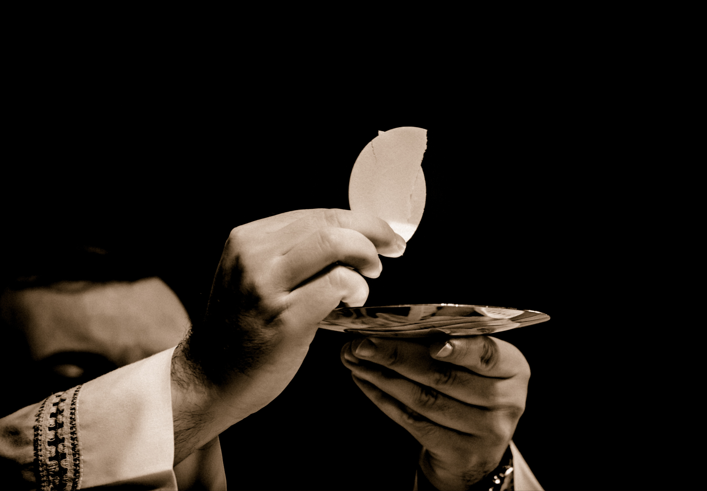
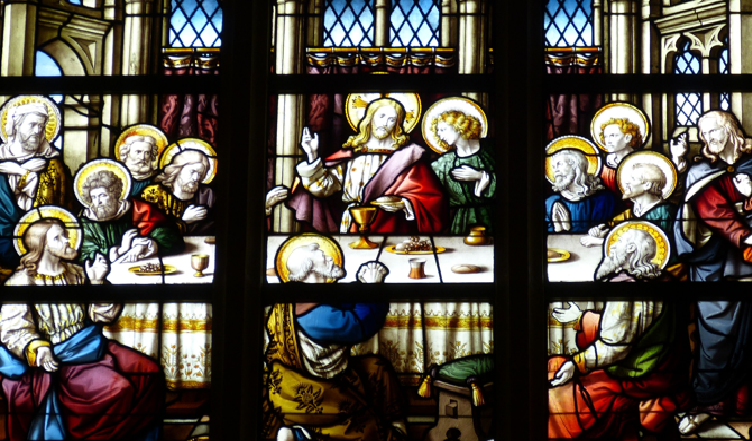
In the Eucharist, Jesus gives us weekly something we can do to help root our lives in God’s love. The Eucharist helps to root us in God’s love because – and while we’re with Isaac in the East, we’ll borrow a word from the East – [the Eucharist helps to root us in God’s love because] of ἀνακεφαλαιώσασις,which means to “sum up” or to “bring together” into the “head.” Jesus in his body gathers up, he anakephalaiósis-es,in love all humanity, every person who has ever lived, and through things he has created, the bread and the wine, through his creation he draws us into and makes us fully alive with him in his body such that all is alive and filled with God. The Eucharist immerses us in, and we take into ourselves, the deep, wide, infinite love of God for all humanity and creation. And God asks that we make a “return” of His love, not because we “should” or “ought” to love Him, and certainly not because our serving Him is ever a matter of our own accomplishing or achieving. But God asks that we make a “return” of His love because when we allow ourselves to be gathered up and taken into Him, “the King who lives by love,” we cannot but help to love Him in return. Today in the Eucharist I pray that we may have the grace to receive this love, and then go out and be this love.

















Homily for the Marriage of Joel Diamond and Eliza Cotter

Homily for the Feast of the Baptism of Our Lord