On the Run
Homily for the Feast of St. Michael and All Angels
September 29, 2026
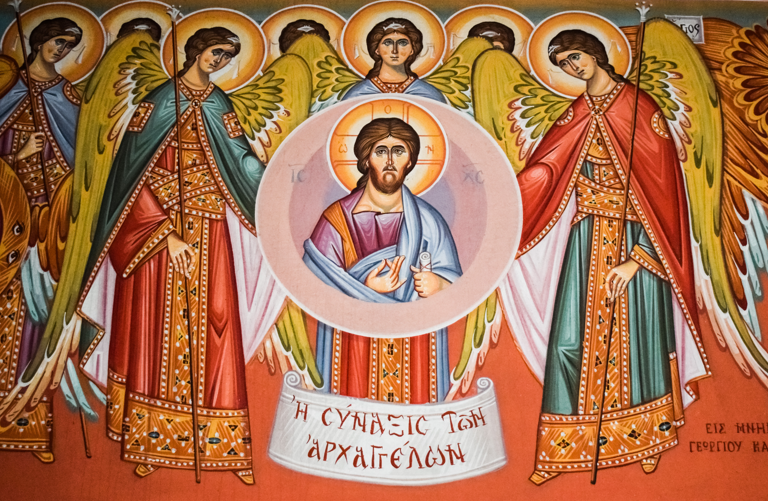
Homily for the Feast of St. Michael and All Angels
September 29, 2026
Homily for Tuesday, September 29, 2026
The Feast of St. Michael and All Angels
Genesis 28:10-17
“And [Jacob] dreamed that there was a ladder set upon the earth, the top of it reaching to heaven; and the angels of God were ascending and descending on it.”
Literature abounds with characters who are on the run. In J.R.R.Tolkein’s The Lord of the Rings, for example, Frodo Baggins flees the Shire across Middle-earth to avoid the ring wraiths. In Mark Twain’s Adventures of Huckleberry Finn, Huck and Jim flee an abusive father and slavery, respectively, rafting down the Mississippi River. In Victor Hugo’s Les Misérables, Jean Valjean for years is “on the lam” from Inspector Javert.
In this evening’s reading from Genesis chapter 28, Jacob, too, is “on the lam.” In chapter 27, Jacob duped his father Isaac into blessing him instead of his brother Esau, who then resolves to kill Jacob (Gen 27:41). “Now therefore, my son,” said Rebekah to Jacob, “flee at once to my brother Laban in Haran, and stay with him awhile, until your brother’s fury turns away” (27:43-44).
I want to get back to Jacob’s being “on the lam,” but first, the medieval rabbis on why in tonight’s text the angels were not “descending and ascending” (as might be expected, given that angels of course live in heaven), but rather (as the text says) the angels were “ascending and descending.” To my ears the most credible explanation comes from the early 12th-century rabbi, Samuel ben Meir, known as “Rashbam.” Rashbam said that “ascending and descending” was a standard idiom and did not indicate the order of action. Rashbam writes: “According to the plain meaning of scripture, the fact that ‘ascending’ is written before ‘descending’ requires no explanation,because people usually mention ascending before descending.” Rashbam’s student, Rabbi Joseph Bekhor Shor,solves the problem of ascending and descending by claiming that, though Jacob saw the ladder, he did not actually see angels. He writes: “According to my opinion, he did not actually see angels going up and down…. But had he seen actual angels, they would have been going down and then afterwards going up.” My favorite of the rabbis’ explanations is that of the 11th-century Rabbi, Shlomo Yitzaki, often called “Rashi,” who believed that what Jacob had witnessed was the angels changing shifts. Rashi writes: “The angels accompanying Jacob in the Land are angels that do not go outside the Land. So they ascended into heaven. And then angels that do go outside the Land descended to accompany him.”
A further note about these angels from a contemporary Hebrew scholar: Alexander Rofé points out that in contrast to every other angelic appearance in the Hebrew scriptures, the angels that appeared to Jacob neither said anything, nor did they have a task or mission for him. Jacob merely saw the angels, and then the text says, “the Lord stood beside him.”
Like Jacob, aren’t we all in some way “on the lam?” Maybe we’re fleeing bad memories, say, of failure or disappointment. Maybe we’re fleeing a person, such as an ex-or a co-worker. Maybe we’re trying to flee an unflattering image we have of ourselves. Or maybe we’re trying to flee anxiety about money, work or health. And in our flight, like Jacob, we find ourselves away from “home,” on unfamiliar ground; and like Jacob we find ourselves in the dark.
For those of us “on the lam,” it could be that the unfamiliar ground on which we find ourselves, and the darkness in which we find ourselves, is perhaps just the place where God is most easily able to encounter us. On familiar ground and in the light, we might not always see, or we might try to ignore, or we might even try to resist God. But as with Jacob, God delights to come to us in our places of “exile.” Like Jacob, we neither need to accomplish nor prove anything for the Lord to come and stand beside us. As God came to Jacob just as he was – fearful, sinful and fleeing – so does God come to us just as we are. And – like Jacob – it could be that when we wake and look back on the “night” that has passed, we will know that, “The Lord is in this place, and I did not know it,” that in retrospect our journey through “night” has been a revelation, maybe even it has been “awesome.”
While I don’t know if some angels are assigned to minister only in certain places and if the angels therefore might change shifts as we pass from place to place, I do like Rashi’s bigger point that, no matter where Jacob went, whether inside the Land or outside, the angels accompanied him. On our journey, too, like Jacob’s, no matter where we are, no matter what we may have done, no matter how afraid we might be, yet God is there and God’s angels are there, assuring us and beckoning us into a place of greater blessing.


Homily for the Seventeenth Sunday after Pentecost

















Homily for the Marriage of Joel Diamond and Eliza Cotter

Homily for the Feast of the Baptism of Our Lord