Holding Each Other Accountable
Homily for the Fifteenth Sunday After Pentecost
September 6, 2026

Homily for the Fifteenth Sunday After Pentecost
September 6, 2026
Homily for the Fifteenth Sunday After Pentecost
September 6, 2026
Matthew 18:15-20
Shortly after I came to Trinity(nearly twenty years ago!) and was wanting to come to better know the parish, I asked at a Vestry meeting questions such as, “Tell about a time when you felt Trinity was truly carrying out its mission.” Or, “What does it mean to you to be Christian?” and, “In what ways might we wish to be Christians together?” I remember asking also, “In what ways is Trinity Parish willing to hold each other accountable?” After a few moments’ silence, one of the members said, “We’re not.”
The homily this morning is about accountability in Christian community.
Matthew chapter 18, from which this morning’s Gospel comes, contains the fourth of Jesus’ five great speeches in Matthew. Some call this fourth speech Jesus’ “Discourse on the Church.” Jesus’ discourse arises from his disciples’ question, “Who is the greatest in the kingdom of heaven?” Jesus’ response sets the tone for the chapter: “He called a child, whom he put among them, and said, ‘Unless you change and become like children, you will never enter the kingdom of heaven. Whoever becomes humble like this child is the greatest in the kingdom of heaven’” (18:3-4). In his “Discourse on the Church” Jesus makes clear that in the kingdom, those who are “great” are those who are humble. As we are together in the Church, it helps to remember that in the kingdom, those who are great are those who are humble.
In today’s Gospel lesson Jesus said, “If a brother or sister sins against you, go and point out the fault when the two of you are alone.” To point out another’s fault may seem like the opposite of humility. For didn’t Jesus tell his disciples earlier in Matthew, “First take the log out of your own eye, and then you will see clearly to take the speck out of your neighbor’s” (7:5)? But pointing out another’s fault does not negate Jesus’ earlier words – the soul searching needed to find the log in our own eye must precede pointing out another’s fault. Keeping in mind Jesus’ words at the end of today’s Gospel – “For where two or three of you are gathered in my name, I am there among them” – my sense is that what Jesus ultimately is saying to us in this morning’s Gospel is that in Christian community – in which we sometimes might wonder who is the greatest, and in which we sometimes might need to be reminded that those who are humble are the greatest – [in Christian community] inevitably there will be sin, and inevitably there will be conflict; and to know that even where there is sin and conflict, yet there is Jesus; and then of all times are we called to practice humility.
In his Discourse Jesus makes clear that we bear responsibility to each other. Elsewhere in chapter 18 Jesus says, “If any of you cause one of these little ones who believe in me to sin, it would be better for you if a great millstone were fastened around your neck and you were drowned in the depths of the sea.” Or again (in a passage we will hear next week), “Lord,” asked Peter, “if a brother or sister sins against me, how often should I forgive? As many as seven times?” “Jesus said to him, ‘Not seven times, but, I tell you, seventy-seven times.’” In his Discourse Jesus reminds us that we bear responsibility to each other, that we are accountable to each other, and that our sin bears on the wider community.
I hope that, were a brother or sister to sin against us, we would “go and point out the fault when the two of [us] are alone.” And I hope that we as a community, when the occasion arises – and as we have done in the past – [I hope we] have the capacity to set boundaries and to hold each other accountable to what we consider appropriate norms. And I pray that when we do so, we do so with the humbleness of a child, and also first having examined our own eye and taken the log out before we try to take the speck out of our neighbor’s.
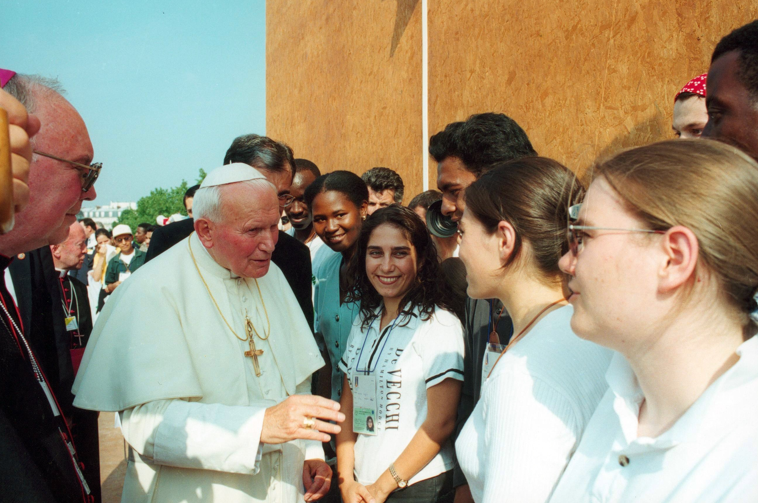
Perhaps another, parallel path to follow Jesus’ words about sin and accountability is the inverse; which is, inspiring one another to greater holiness. “Holiness” might seem like a lofty goal, but “holiness” is something toward which we all can strive and perhaps even in some small way attain. Pope Francis writes about “saints next door” who are the “middle class of holiness:”
The Holy Spirit bestows holiness in abundance among God’s holy and faithful people…I like to contemplate the holiness present… In those parents who raise their children with immense love, in those men and women who work hard to support their families, in the sick…. In their daily perseverance, I see the holiness of the church…. Very often it is a holiness found in our next-door neighbors, those who, living in our midst, reflect God’s presence… We might call them “the middle class of holiness.” (Guadeteet Exsultate, 6-7)
To practice inspiring each other to this attainable, “middle class of holiness…” We can do simple things like being present for worship Sunday by Sunday – our presence supports others more than we know. We can inspire one another to holiness by being part of a group such as the Baptismal Preparation Group, in which we reflect on scripture and share with each other how our heart hears its message. We can inspire one another to holiness by paying attention to God’s presence in our lives and by sharing that experience of God with one another (as we do at each Vestry meeting). We can inspire one another to holiness by giving generously to God and God’s work here at Trinity Parish. We can inspire one another to holiness by praying for each other. By practice and with God’s help, and perhaps with the inspiration of one other, we can all hope to become a “saint next door.”
We are imperfect human beings living in an imperfect world – of course we will sin, often against one another. I hope that when we do, we humbly take responsibility and seek to reconcile. And I hope likewise on this road of mutual accountability in regards to sin, that we also might walk the parallel path of inspiring one another to holiness.
I will leave us with a quote about holiness and community from Pope Francis:
“It has pleased God to make men and women holy and to save them, not as individuals without any bond between them, but rather as a people who might acknowledge him in truth and serve him in holiness.” In salvation history, the Lord saved one people. We are never completely ourselves unless we belong to a people. That is why no one is saved alone, as an isolated individual. Rather, God draws us to himself, taking into account the complex fabric of interpersonal relationship present in a human community. God wanted to enter into the life and history of a people. (Gaud et Ex, 6)




Homily for the Seventeenth Sunday after Pentecost
















Homily for the Marriage of Joel Diamond and Eliza Cotter

Homily for the Feast of the Baptism of Our Lord