Giving Back to God
Homily for the Twenty-First Sunday after Pentecost
October 18, 2026

Homily for the Twenty-First Sunday after Pentecost
October 18, 2026
Homily for October 18, 2026
The Twenty-First Sunday after Pentecost
Matthew 22:15-22
Even more than Mark and Luke,Matthew is hostile to the Pharisees. Today’s Gospel comes from that section of Matthew between Jesus’ entry into Jerusalem on Palm Sunday and his crucifixion on Good Friday. During this week, in these chapters, Matthew’s hostility to the Pharisees is on full display. In the Gospel two weeks ago, for example, Jesus told the Parable of the Wicked Tenants – “Therefore, I tell you,” Jesus said,“the kingdom of God will be taken from you (Pharisees!) and given to a people who will produce its fruits” (21:43). And last week Jesus told the Parable of the King’s Wedding Banquet in which “Many are called, but few are chosen,” with the Pharisees being among those not chosen. And in today’s Gospel lesson,when the Pharisees “plotted to entrap Jesus in what he said” – “Is it lawful to pay taxes to the emperor, or not?” – Jesus not only calls them “hypocrites” but in a meme-worthy moment puts them in their place: “Show me the coin used for the tax!” Jesus said:
“Whose head is this, and whose title?” They answered, “The emperor’s.” Then he said to them, “Give therefore to the emperor the things that are the emperor’s, and to God the things that are God’s.”
Matthew makes clear in his Gospel that the Pharisees are not interested in the fruits of Jesus’ ministry, such as inner change or a Gospel that enables human beings to live with hope. But in Matthew the Pharisees are concerned with meticulously keeping the Mosaic law – like on the Sabbath allowing someone to rescue his sheep out of pit but objecting to Jesus healing a man with a withered hand (12:9-14); or insisting on the tithing of mint, dill and cumin, but neglecting the weightier matters of justice, mercy and faith (23:23). Whether the historical Pharisees were indeed as zealous for the law as Matthew portrayed, or whether Matthew merely caricatured them in order to highlight by contrast Jesus’ compassion and mercy is unclear. But what Matthew is clear about is that it is Jesus – and not the Pharisees – who is compassionate and merciful, and who cares for our souls.
Jesus’ care for our souls extends to money. Today’s Gospel lesson is not the first time in Matthew Jesus has spoken about money and divided loyalties. In the Sermon on the Mount,Jesus said: “No one can serve two masters, for a slave will either hate the one and love the other... You cannot serve God and wealth” (6:24). What Jesus touches on here primarily is the Hebrew insistence that there is only one God – “You cannot serve God and wealth.” What he touches on secondarily is that – for those in the Roman empire as well as for us – it is easy to make money a second “god.” And – as the scriptures insist, and as we may know from our own experience – only one God cares for our souls.
There are a few “moves” that Matthew makes in his telling of the story that not only help to set up Jesus’ punchline– “Give to the emperor the things that are the emperors, and to God the things that are God’s” – but that also tap into images of how God cares for us. First, the coin itself – “Show me the coin used for the tax,” Jesus said. “And they brought him a denarius.” “Whose image is this, and whose title?” Jesus asks. On the front side of the denarius they would have seen an image of the current emperor, Tiberius Caesar, and also the words: “Tiberius Caesar, Divi Augusti Filius,” meaning “Tiberius, son of the divine Augustus;” and then the title, “Augustus,” meaning“venerable” or “majestic.” Had Jesus flipped the coin around, on the obverse side they would have seen another inscription: “Pontifex maximus,” meaning, “high priest.” The inscriptions not only hint at Tiberius’ inflated opinion of himself, but more significantly for Jesus and the Pharisees they make the claim for other possible “gods:” money and the emperor. Second,the Pharisees would have been hard-pressed to ignore the connection between Jesus’ teaching about the coin and Genesis chapter 1. If on the coin was stamped the image of Tiberius Caesar, recall that in Genesis God stamped his image on a human being: “Let us make humankind in our image,” God said (Gen 1:26). Further,the Greek behind our translation of the Pharisees’ flattering words to Jesus –“for you do not regard people with partiality” – could also be translated, “for you do not look upon the face of people,” possibly setting up a pun with “you hypocrites” in the next line. Recall that a ὑποκριτής in the ancient world was an actor – literally, “under a mask” – someone who wore a mask over their true face. And lastly, though it is not possible to see in our translation, the Geek word used by the Pharisees for “pay” taxes to the emperor is δίδωμι, which means “to give.” But the word Jesus uses for “give” in “Give to God the things that are God’s” is ἀποδίδωμι, which means “to give back.” In Matthew people “give” to the emperor but “give back” to God.
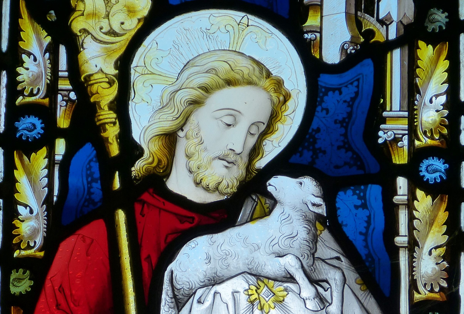
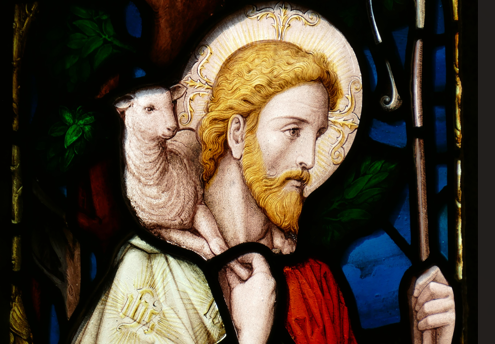
These “moves” that Matthew makes in his telling of the story do not merely set up Jesus’ punchline of, “Give to the emperor the things that are the emperor’s, and to God the things that are God’s,” but they also connect to images of how God cares for us. Jesus’ teaching about the inscription on the coin reminds us that there is only one God, and that our one true God has come, not to steal, kill and destroy (like the false “god” that is the emperor), but rather God has come as a Good Shepherd who gives us life and gives it abundantly. Jesus’ question about the image on the coin reminds us that we have been “stamped,” not with any secular image, but with God’s image, and no matter how much another “god” may try to imprint upon us his image, we belong to God. The possible pun about “the face of people” and also “hypocrite” reminds us that, in contrast to the emperor who must post his name and image on physical things in order to try to be before his people, our God is able to truly care for us because he relates to us personally and face-to-face. And though the emperors of this world expect others to give to them, we Christians know that everything comes from God. Though we might “give” taxes to the emperor,we “give back” to God.
In contrast to how the “emperors” of this world “care” for people – by taxing or even extorting them, by making sure their image is ever before them, by wanting to be the object of devotion or even “worship” – in everything our God does he is merciful and just and true and good. Our God has made us in his image and made us to be his. Our God has come to live among us that we may have life and have it abundantly. Our God relates to us personally and face to face. Our God never withholds – and he certainly doesn’t take – but he gives and gives and gives again.
I wonder, to what extent might you bow down to false gods, such as (perhaps) money? I wonder, if someone were to look at your spending and also your calendar, what might they conclude is the most important thing in your life? Looking at your spending and your calendar, would they know that God is important to you? There are many false “gods” in our world, and to some extent like those living in first-century Palestine we must “give to the emperor.” But following Jesus’ command let us give to the emperor only the things that are the emperor’s, and give back to God the things that – if we are honest with ourselves – we know are God’s.



Homily for the Seventeenth Sunday after Pentecost




















Homily for the Marriage of Joel Diamond and Eliza Cotter

Homily for the Feast of the Baptism of Our Lord